- Care-to-Collection Automation
- Clinical orchestration platform.
- Clinical AI Documentation
1 min. read
For years, healthcare technology has tried to fix clinician burnout by treating symptoms instead of systems.
More tools. More overlays. More point solutions that promise speed, while quietly creating fragmentation downstream.
At Matic, we made a different call early on:
Start with clinical intelligence that can carry context forward. Then orchestrate everything that follows.
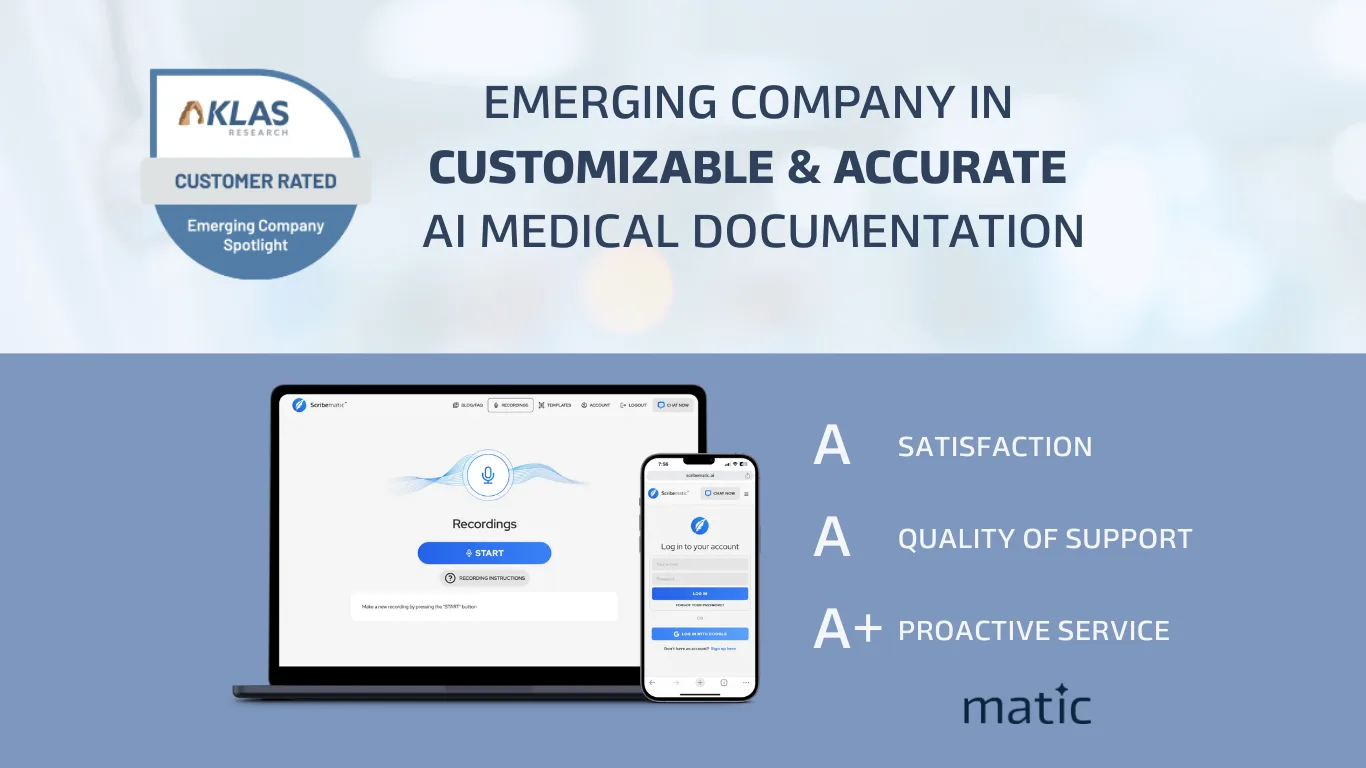
That belief is why Scribematic exists. It’s also why Scribematic was recently recognized by KLAS Research as an Emerging Leader in AI-driven customizable and accurate clinical documentation.
We’re proud of the recognition, but more importantly, we see it as a signal: the market is ready to move past “AI scribes” and toward something more durable.
Documentation is where care is captured, but it’s rarely where care ends.
The clinical note drives:
When documentation is rushed, generic, or stripped of intent, everything downstream suffers. Denials increase. Context disappears. Clinicians rework charts. Burnout compounds.
Most AI scribe solutions stop at transcription. We didn’t.
KLAS highlighted Scribematic’s accuracy, customization, and support responsiveness—but those are outcomes of a deeper architectural choice:
Build AI that understands clinical context and preserves it across the lifecycle of care.
That’s what we mean by orchestrated clinical intelligence.
Not AI layered on top of workflows. Not automation that breaks intent. But agentic systems that work inside real EHRs, real specialties, and real clinical environments.
KLAS feedback reinforced what we hear every day from customers:
That’s not accidental. That’s orchestration by design.
One of the strongest themes in KLAS feedback was customization, and for good reason.
Healthcare isn’t uniform. Specialties differ. Organizations differ. Clinicians differ.
Generic AI fails quietly.
Scribematic enables organizations to:
When clinicians say, “We can make the note look exactly the way we need it to,” they’re describing trust.
And trust is the prerequisite for scale.
At Matic, customization isn’t a workaround. It’s a strategic design choice.
Our platform is built to be:
This approach accelerates adoption, reduces risk, and strengthens long-term value. Over time, what begins as tailored becomes standardized, without losing clinical nuance.
Scribematic is the foundation, but it’s not the end state
Once documentation is accurate, structured, and intent-preserving, it can safely power everything downstream:
As organizations expand with Matic Clinical Intelligence Platform, they activate additional Matics, each extending intelligence across the care-to-collection lifecycle:
Together, these solutions orchestrate intelligence across the care-to-collection lifecycle without fragmented tools or parallel workflows.
Healthcare doesn’t need more AI features.
It needs systems that respect clinical reality.
AI scribes are easy to build. Making them reliable under real-world conditions, where accuracy, standards, and downstream impact matter, is much harder.
KLAS recognition confirms that Scribematic succeeds because it starts in the right place: the clinical note, captured correctly, with intent preserved.
AI scribes are easy to build. Clinical intelligence that holds up under speed, scale, standards, and downstream impact is not.
Our goal was never to win a documentation category. It was to build an intelligence platform that respects how care is actually delivered—and improves everything that depends on it.
KLAS recognition tells us we started in the right place. Now we’re focused on what comes next. Learn more about Matic at https://maticinside.ai/contact.